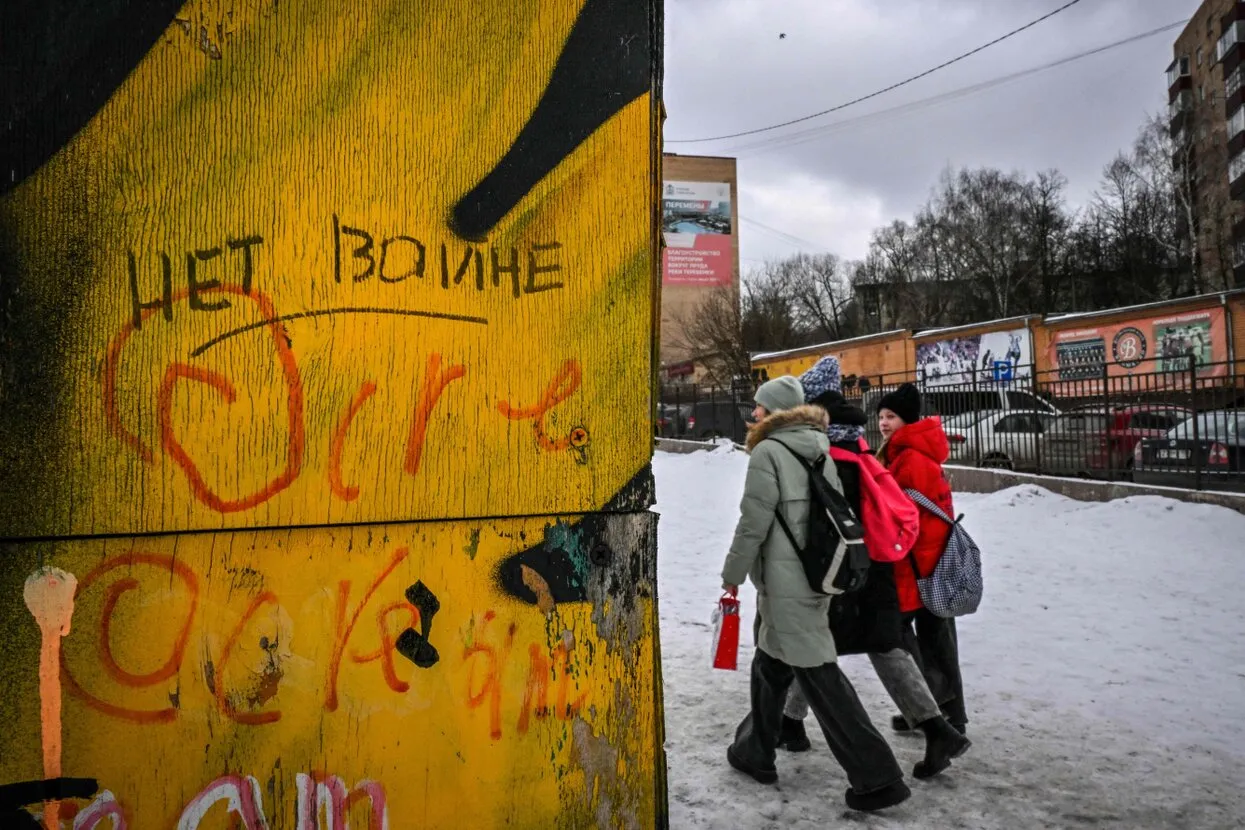
These Russians were children when Putin launched a full-scale war against Ukraine. Four years later, here’s what they think about their country — and their future.
As Russia’s war against Ukraine enters its fifth year, a new generation of Russians is coming of age. Despite state pressure and propaganda, not all of them support the ongoing invasion. Meduza asked four young Russians with anti-war views to explain how the past four years have shaped their sense of self, their country, and their hopes for the future. The following is a translation of their accounts, abridged for length and clarity. All names have been changed for security reasons.
Polina, 20
College junior, studying journalism. Born in a small town in Siberia, moved to a larger city to study.
I was 16 in 2022. I remember the day the [full-scale] war began. At the time, I wasn’t subscribed to any news channels [on Telegram], so I didn’t learn about it from independent sources.
Our first class that day was history. We discussed what had happened. Everyone was in complete shock and horror. Our teacher spoke about it in mostly negative terms, [focusing on] universal human values and how war is wrong. But at the same time, she said the government “knows what it’s doing,” that for some reason it was necessary: “We don’t know why yet, but we will definitely learn the reasons.”
No matter how hard I’ve tried to find those reasons, I still don’t understand.
At the time, I was writing for a youth newspaper run entirely by teenagers. I was on the bus heading there when I saw a sheet of notebook paper taped to a pole that said “No to war.” I didn’t even know how to feel about it — there hadn’t been any protests yet. It was just a piece of paper hanging there. But on my way back, it was already gone.
We talked about it in the newsroom, too. Back then, no one was afraid to speak up. Of course, we didn’t write anything about [the war]. Organizations like those barely survive as it is — they exist on state grants. Before the [full-scale] war, we even published sharp social commentary, and no one stopped us. Now something like that could simply get you shut down. The grant situation has gotten worse, too — they’re given to projects connected to the “special military operation.”
Meduza has condemned Russia’s invasion of Ukraine from the very start, and we are committed to reporting objectively on a war we firmly oppose. Join Meduza in its mission to challenge the Kremlin’s censorship with the truth. Donate today.
When you’re 16, you think you have this huge future ahead of you — that you’ll get into some great college, move somewhere new. But then stores started closing, places we used to go with friends shut down. You realize you won’t get into certain colleges, even Russian ones, because spots are being reserved for the kids of those fighting in the war. And overall, the financial situation keeps getting worse.
It was hard to grasp that somewhere, right now, people were being killed. Your own life hadn’t changed much — but over there, people were dying. It was strange to see the constant news with these horrific numbers of dead and wounded. A war is happening, and you’re doing nothing — and you don’t even know what you could do.
When the [full-scale] war began, I realized I didn’t understand anything. To make sense of it, I had to learn a lot: what was happening, who was responsible, how it developed, what came before. Back in 2014, the slogan “Crimea is ours” was just a meme to me. I didn’t understand that it was a fascist slogan. It just seemed funny. As I learned more, I figured out which bloggers I liked, who I agreed with, and who I didn’t.
At college, I’m not gaining any knowledge that could actually help me in life. But at least we don’t have diehard defenders of the authorities telling us we should go work for [state-run TV station] Channel One. There are still professors who speak to you like human beings.
I look at people who graduated a few years ago. They enrolled thinking, “Wow, journalism — I’ll change the world, I’ll write the truth, I’ll get into TV Rain, Meduza, some cool outlet, and I’ll have an amazing life.” Our generation enrolled simply because we’re humanities students.
Life today is very different even from a year ago. Even thoughts about the war feel completely different from the first years. Your psyche just can’t handle constant stress, so you switch to personal problems. In that sense, propaganda doesn’t even need to do anything. The war has simply become normalized. It’s awful, but there’s nothing you can do about it.
I’m not especially close with my classmates, but I live in a dorm. We constantly talk [about what’s happening in the country]. We’re in our third year now, so we have to think about the future again. There’s this fear: if we leave, we’ll miss the moment when Russia becomes free. But if we don’t leave, they’ll close the iron curtain and we’ll never get out at all. To be or not to be — that’s the question we’re constantly asking. For me, it’s the main question right now.
Makar, 18
College sophomore, studying law. Lives in central Russia, volunteers with the Committee Against Torture, and is a member of the unregistered political party Rassvet.
When the [full-scale] war began, I was 13. Because I wasn’t personally engaged [in politics], I initially supported the “operation” — which I can now calmly call a war. But after about three months, with the help of friends and people I knew, my eyes were opened. I realized things weren’t as rosy as they had seemed.
What affected my position most, I think, was the killing of civilians. The Russian side declared it was going in to “protect civilians,” but I saw that they were behaving in the very ways they accused Ukrainians of. I was already using Telegram by then, though I was still on VKontakte, damn that thing. At that point, VKontakte wasn’t as heavily censored, and there were still some reasonably sane voices there. They were showing what was really happening.
The war hit my family from the very beginning. Some of my relatives were mobilized; sadly, they were killed. It was incredibly painful — these are people I love, people who matter to me. I only found out they were there after some time had passed, when nothing could be done. Two were mobilized, and both came back in coffins.
Back then, I wasn’t yet 18. Now conscription is a real threat. As long as I’m studying, I have a deferment. But in practice, as we’ve seen, boys are expelled more often — sometimes on fabricated grounds. I’m afraid that could happen to me, especially because of my political activity.
My classmates know about it. And given that many of them support the war, there’s always the fear that one day they could report me. There have been cases of students being expelled over their views or for things they said in class. Sometimes the reports even came from professors. There’s also been harassment of LGBTQ+ people — and that includes me.
Military officers come to our university to give lectures about “unity and cohesion on the front.” Attendance isn’t optional. If you don’t show up, you’re summoned to the office. There are also open appeals to sign military contracts and take academic leave to do so.
I’m planning to emigrate and am currently looking for the means to do so. I’d like to return to Russia someday, but only after this wave of totalitarian pressure has subsided and this oppression is gone. I volunteer because many organizations have lost access to financial, material, and administrative resources. I think it’s important to help them, and I see that they genuinely benefit society.
Most of my friends are part of the queer community. We support one another. In our city, it’s a small circle — everyone knows everyone, but meeting [someone new] is quite scary. You don’t know what someone is like on the inside. They may be queer, but they also may have absorbed state propaganda.
I know of many people who are loyal to the authorities and also queer. Recently, I met someone on a dating app who turned out to be a member of [the ruling party] United Russia. When I realized that, I was so frightened that I immediately deleted all our messages.
Society right now feels embittered. It’s passive; people don’t help each other. I hope that by the time I finish my education, the war and this wave of repression will be over. People will open their eyes, see what has happened, understand that things aren’t as good as they seemed, and change. As for me, I’ll continue what I’m doing. I’ll keep trying to change this world for the better.
Marina, 19
Sophomore, studying law. Grew up and lives in Moscow.
I’ve always read a lot of news, but I didn’t really know the historical context behind any of it. In 2022, when people started saying that something might happen, I didn’t take it seriously. I had plans — for school, for travel. I thought it was just another round of [unrealistic] predictions that would never come true.
Even on February 24, I didn’t fully grasp what it all meant. I tried to find information, asked people questions, but it felt like it had nothing to do with me. I didn’t understand the scale of it.
At the time, my social media algorithms — especially TikTok — pushed me onto the side where everyone supported Russia. Honestly, I don’t even know how that happened, because I’d never been on that side before — not in my circle, not online. I always thought patriotic movements wouldn’t reach me. But I was immersed in that environment until TikTok was blocked.
I remember thinking that something strange was happening, but maybe it wasn’t so bad. It felt temporary, like it would pass quickly, and that Russia couldn’t possibly do anything truly terrible. But then I started reading other sources and talking to my family. Then they closed our airspace, travel became harder to plan, and that’s when I realized it was starting to affect me.
My parents have always been against Putin. But at the time, I don’t think we really talked about it. We never sat down and discussed it openly. I’d always held opposition views myself. It felt like that was true for our whole generation. But when I realized how TikTok had shaped my opinion [in those first days], it scared me. I thought I needed to start drawing my own conclusions and develop critical thinking. I follow the news, what our opposition figures think, and what they say about what’s happening in the world.
In my first year [at college], we had a course called “Fundamentals of Russian Statehood.” It was mostly history we already knew. We were supposed to get to current events but never did. Still, we had online tests with questions like when the “special operation” began and which territories had been annexed.
I honestly have no idea what most of my classmates think. Even the ones I’m close to — I don’t really know their position. Now that you can be fined or even jailed for almost anything, people don’t express their opinions. But I do have friends I talk to about what’s happening. It’s comforting when someone gets you. Some of them have left Russia; we don’t see each other often. But when we do, we talk about all of this.
When you’re a kid, you don’t expect that you’ll grow up and the economy and political situation will be bad. I feel like since I’m still young, I should live to see better times. Sooner or later they have to come.
I hope I finish my degree. Of course, I’ve thought about dropping out and leaving. But I’ve already studied for two years — it feels too late to quit. Maybe by the time I graduate, it will all be over — or at least the war will be over and things will be a little better. Or maybe much better — if Putin dies. Maybe I’ll go abroad for a master’s degree. But I hope I’ll be able to come home in peace.
Sergey, 20
Studies at a pedagogical college in a large city
I turned 16, and a couple of days later the [full-scale] war began. I was in ninth grade. I understood it might happen when I read news about Russia concentrating troops for “exercises” near the Ukrainian border. I told people that a war might start soon. And then it did. When it happened, it hit me hard.
I was active in opposition spaces online, didn’t consider Crimea Russian, and understood that the same thing had happened back then — Russia had illegally seized territory. I couldn’t support the war because it means killing. I saw no objective reasons to start it. I don’t believe war can solve conflicts at all. War is an escalation — it only multiplies problems.
At first, everyone at school tried to ignore it, or maybe they were just in an information vacuum. We didn’t talk about it with teachers or classmates. It felt like no one even knew [it was happening].
My whole family holds opposition views. Only my grandfather, unfortunately, was brainwashed by the TV. Before the war, he didn’t support Putin — he used to say he was like a tsar, that he’d rule as long as he wanted. We agreed on that, and I was glad about it. But once the [full-scale] war began, he suddenly immersed himself in television, even though he’d barely watched political shows before. It was impossible to convince him it was propaganda.
What I remember most vividly about 2022 is the beginning of the war, my graduation from ninth grade, and how I would walk at night where there were no cameras or lights, sticking up leaflets with tape wrapped around my fingertips so I wouldn’t leave prints. There was one day at school when I felt ill. It felt like the end of everything. Just emptiness.
Before the war, I’d planned to study psychology in Europe, but those plans collapsed. The college I’m at now is a terrible institution. From the first day, I wanted to drop out, even though I used to imagine that I’d be a model student at college.
It’s a Z-university. You walk in and immediately see ads for military contracts, drone units, flyers everywhere. There’s a big screen playing promotional videos. We have a “gallery of heroes” — portraits of soldiers who fought in the war line the corridors. They bring groups through on tours and tell stories about them. Once, [right before class,] we were told without warning that we were about to write letters to soldiers at the front. I said I needed to step out and left. In general, you can carefully navigate around things.
Since 2022, life has felt like a nightmare. I think things started going wrong after [Russian opposition politician Alexey] Navalny was poisoned [in 2020] — or maybe even earlier, when the crackdowns on protests intensified. Everything deteriorated then. Maybe it’s also because I was growing up and losing that childhood carefreeness.
It feels like people have become bloodthirsty. They seem kind and decent, and then you hear what they say about the war and about Ukrainians. Year after year it continues: people die, people are taken away, acquaintances go off to fight. Someone you used to talk to just disappears without a word — and you find out they’ve gone to the front.
It’s endless darkness. There’s no light in sight. Friends are labeled “foreign agents,” imprisoned, detained, searched. Every week you hear that something has happened to someone you know.
When a war drags on for so long, you start to get used to it — which is horrifying. At first it was unbearable to watch, so I threw myself into activism and volunteering. I still do it, but I hardly read the war news anymore.
I’m studying psychology and have a student deferment [from conscription], which is the only reason I haven’t dropped out. I don’t know what to do — I’m afraid. I thought about applying for a master’s degree, but I don’t want to get it in Russia.
In class, we’ve been told that in the future we’ll inevitably work with veterans of the war — that there will be many of them and high demand [for psychologists]. At first, I was completely opposed to that. I thought I would never interact with them. I didn’t even consider them human if they chose to go kill others for money. I believed that even those drafted could surrender or somehow boycott it. I myself would rather die than go kill someone.
But recently I’ve been discussing this with other activists, and they changed my mind. We talked about launching projects to help veterans adapt to civilian life, because the state won’t do it. Our peaceful future in this country depends on it. After thinking it through, I realized I’m ready to do that. It would be very hard, but it would help civilians who didn’t take part in [the war].
The state has betrayed these soldiers, too. They could become agents of change if they’re engaged with properly. It’s painful, but sometimes you have to compromise with your conscience, your mind, your heart — for something bigger. If change in this country requires that kind of compromise, I’m ready for it.
Special Military Operation
The Kremlin’s euphemism for its full-scale war against Ukraine